

Author: Nedžad Junuzović
We are witnessing the exponential development of innovative technologies, as we have written about before. However, the speed of adoption of new technologies in organizations is often much slower, which causes a gap between technological capabilities and effective application in business. Those who overcome this gap will gain an advantage in the market. The more efficient and effective the digital transformation process is, the more successful the organization will be.
Experience from practice, implementation challenges
A recent conversation with the director of a larger company shows that resistance to new software projects often stems from previous experiences of complex and exhausting implementation.
Director: “The head of finance told us that we are not planning on introducing any new software in the next two years at least.”
Consultant: “What software are you using now? I assume you are happy with the current solution?”
Director: “Yes, we have one ERP system and we are not very satisfied with it”
Consultant: “Now I’m a little confused. You’re not really satisfied and yet you don’t want to do anything in the next two years?”
Director: “You see, we have already spent so much time and energy in introducing the new ERP system, so we don’t want to go through all that again.”
I believe that from this short conversation you can feel the pain that is present, which is clearly far greater than the perceived potential benefits that new technology certainly brings. We created the popular “5 Whys” diagram to identify typical causes that lead to a lot more energy and time being invested in the implementation of a software project than planned. Of course, we do this in order to better understand the causes of the problem, instead of possibly acting only on the consequences.
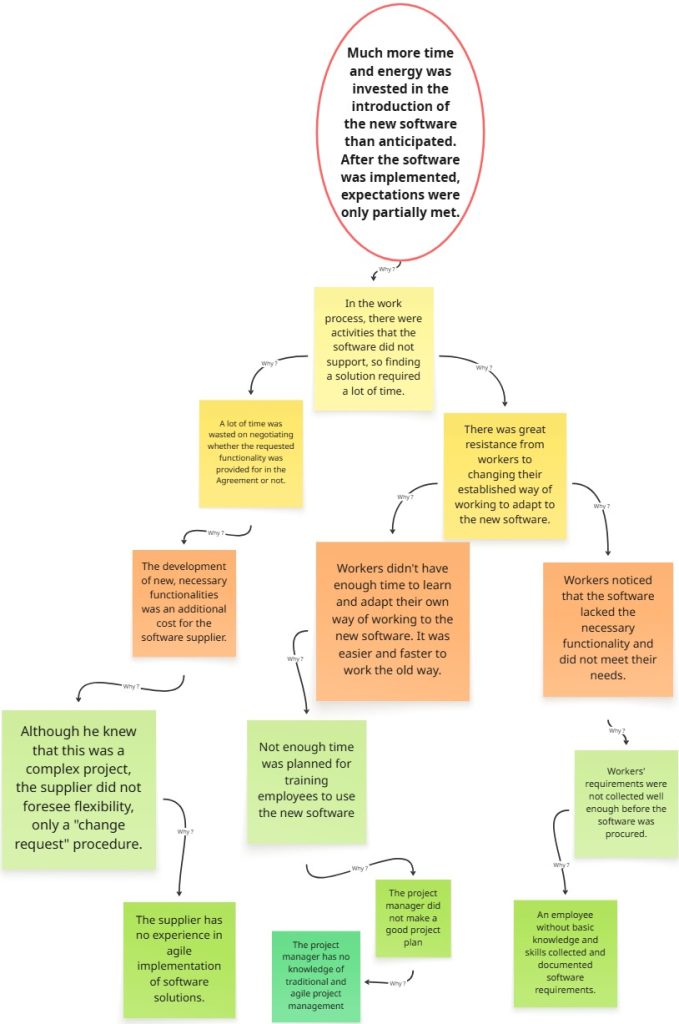
The difficulties are numerous: from lack of functionality, employee resistance to change, to inadequate training and poor requirements planning. The example analysis in the image clearly shows how numerous factors from different segments of the organization slow down and hinder the successful implementation of a software solution. It is important to note that the key causes of problems are mostly outside the scope of the projects themselves and that they should be solved where they arise. We see that, in this specific example, the problems mentioned concern the way software is procured, project managers are delegated, project manager training, etc.
How to facilitate and accelerate the digital transformation of an organization
If we want software solution implementations to be faster and more effective, we need to take a systemic approach. This means that we need a system for implementing digital transformation projects. The system consists of educated people who apply certain tools (“5 whys”, collaboration software, etc.) to carry out the digital transformation process. Although the activities of the aforementioned digital transformation process are different for each organization, its phases are the same regardless of the size of the organization and the industry to which they belong:
- Formation of a digital transformation team consisting of managers, experts from business sectors and IT experts.
- Analysis of the current state and assessment of the organization’s digital maturity.
- Creating a digital strategy based on the results of the analysis of the current situation, with clear goals, KPIs and a portfolio of projects that will be implemented in the next year to a maximum of two years.
- Implementation of digital transformation projects from the digital strategy portfolio using best project management practices (project portfolio management, agile leadership, team education, etc.).
- Continuously measuring results and adapting approaches to new insights and challenges.
Conclusion
Organizations that set up digital transformation systematically, with clear steps and a strategic vision, adopt modern technologies faster, easier and with visible results. In the digital age, competitiveness rests on the ability to turn technology into value for customers, employees and owners. Adapt your approach, educate your teams and build a strong digital strategy for success in the market.
A digital strategy is a key step that, among other things, defines how an organization will use digital technologies to achieve business goals. A digital strategy can answer the question of how an organization will use, for example, digital marketing, social networks, mobile technology and analytics to engage more users, help sales and improve its operations. A successful digital strategy enables synergy between IT and business teams towards achieving the organization’s goals. Without a digital strategy, there is a high risk that technology investments are not aligned with the company’s vision and goals.
The more efficient and effective the digital transformation process is, the more successful the organization will be.
Would you like advice on how to modernize your business, accelerate your digital transformation, and achieve better results in the market? Are you wondering where to start on your digital transformation journey? Book a meeting with us. Clicking on the button opens a simple form for selecting an appointment, and consultations are completely free and without obligation. Join the leaders who are improving their business using digital technologies!